Navigation

    Voting Theory Forum

    • Register
    • Login
    • Search
    • Recent
    • Categories
    • Tags
    • Popular
    • Users
    • Groups
    1. Home
    2. masiarek
    3. Posts
    • Profile
    • Following 4
    • Followers 1
    • Topics 30
    • Posts 45
    • Best 16
    • Groups 0

    Posts made by masiarek

    • RE: Simulations of Sincere Smith Compliance under Strategic Pressure

      Again AI Claude assisted 🙂

      @cfrank This is a really generous reply, and it corrects me on two things I got wrong, so let me start there.

      Your objective was already utility-maximizing for each faction, not CW-displacement — so the question I made the most noise about was one you'd already answered. And your generator wasn't impartial culture, it was stress profiles. Both of my sharpest points were aimed at problems you didn't have. Apologies for assuming.

      I spent some time with your plots, and I think they make your own case more precisely than the summary does — including in one place where they cut against your original conclusion.

      The crossover only happens at the PSRO endpoint. Reading off your panels (so ±1 point): at 0% strategic the Smith methods are at 100% CW rate and 0.992 normalized utility against IRV's ~59% and 0.944. At 25/50/75/90% they're at ~90/81/74/70% and 0.987→0.955, against IRV flat at ~61–64% and ~0.937–0.944. So on both the hit rate and the utility measure, Smith methods dominate IRV at every level of strategic participation you tested short of the endpoint — including 90%, where nine voters in ten are strategic. That's a much stronger statement than "the sincere advantage can remain large," and it's your data, not mine.

      Your "outside sincere Smith rate" panel is the cleanest thing in the set. IRV sits flat at roughly 36–40% at every level, including 0%. It elects outside the sincere Smith set about 40% of the time with nobody lying at all. That flat line is the whole reason the convergence appears: strategy has very little left to take from IRV, because IRV has already spent it. The Smith methods start at 0% and are driven up to 25–30% by strategy; IRV starts at 40% and stays. Those are different failures wearing the same number.

      Two smaller things. First, I think there may be an off-by-one between your prose and your plot: you quote Ranked Pairs at 97/90/81/74 for 25/50/75/90%, but the plot reads roughly 90/81.5/73.5/70 at those positions — your sequence looks shifted one notch. Doesn't change the shape, but at 90% strategic it's ~70%, not 74%.

      Second, and I think this matters for the conclusion: at the PSRO endpoint your best method is IRV + fresh runoff, not IRV. It leads on all three panels — ~69% CW rate, 0.964 utility, and the lowest outside-sincere-Smith rate of any method at that endpoint (~31%, while plain IRV is at ~39.5% and Ranked Pairs is at ~56%). So even taking the adaptive regime entirely at face value, the finding isn't "IRV is robust to sophisticated strategy." It's "a second round on fresh ballots is robust to sophisticated strategy" — a claim about two-round structure rather than about Smith compliance, and one that would apply just as well to score-plus-runoff designs. I'd be curious whether that holds up as you vary the runoff's ballot.

      On your mechanism — the CW being pushed out of the Smith set before completion runs. That's a sharp claim and I hadn't separated it out, so I measured it. Single coordinated bloc, burial, rational (it only submits if it beats voting honestly), every challenger tried, swept over 3/5/7/9 candidates at your 71 voters. Ejection is the minority regime everywhere: 19–36% of successful burials remove the CW from the reported Smith set, and the other two-thirds to four-fifths leave the CW sitting inside it, where the completion rule still decides. Interestingly the ejected share barely moves with field size (23%→26% in 1-D from 3 to 9 candidates) even as raw displacement climbs from 20% to 88%. A wider field makes burial much easier without much changing where it lands.

      The obvious limit: that's one bloc doing a plain bury-to-last, not several factions best-responding over rank and score offsets. Ejection is clearly something a stronger search buys. Which I think locates our remaining disagreement precisely and answerably: how much of the ejection rate is purchased by adaptive multi-faction optimization, over and above single-bloc burial? If PSRO is ejecting at 60–70% where a naive bloc ejects at 25%, that's a real and quotable finding about what adaptivity does, and it would be worth a paper on its own. Code's here if it's useful: https://masiarek.github.io/star-voting-library/07_Concepts/topics/compliance_vs_strategic_preservation.html

      On the AI point — I think this is the most interesting thing in your post and I don't want to wave it away, because the direction is right. Three things give me pause about how far it goes:

      Computation isn't the binding constraint. In my runs a successful burial needed 34–40% of the electorate to rank someone they genuinely like dead last. AI can tell you that's the optimal play; it can't get 40% of voters to cast it on trust. That cost is social, and it's the one that doesn't fall with compute.

      The information required is about opponents, not preferences. PSRO converges because it iterates against a live opponent mixture, observing what the other factions actually do. A real electorate votes once, without seeing anyone's final policy. Better tools don't close that gap — they arguably widen the variance, since everyone is now optimizing against a guess about everyone else, and a burial aimed at the wrong equilibrium is exactly the one that backfires.

      Cheaper attacks make cheaper detection, and that cuts toward pairwise methods. A successful burial's signature is a cycle appearing in a race whose pre-election pairwise polling showed a clean head-to-head winner. The thing detection needs is a published pairwise matrix — which is precisely what Condorcet methods emit as a byproduct and what IRV doesn't. If the threat model is "strategic optimization gets cheap," I'd want the method that publishes the most auditable structure, not the least.

      None of which touches your core point, which I think is right and which I've now written up: formal compliance is a property of the cast ballots, "the sincere winner wins" is a property of the electorate plus its behaviour, and treating the first as a guarantee of the second is sloppy. That's a correction advocates on my side of this should absorb rather than argue with. I just don't think it demotes Smith compliance — your own 0–90% panels are about as strong an argument for it as I've seen.

      posted in Voting Theoretic Criteria
      masiarek
      masiarek
    • RE: Simulations of Sincere Smith Compliance under Strategic Pressure

      AI Claude - it helped me to create this response:

      The distinction you're drawing is real, and I think it's underrated: formal Smith compliance is a property of the ballot→winner map, so it can't say anything about sincere preferences the method never sees. Worth separating out explicitly.

      Two things I'd push on before the IRV conclusion, though.

      First, the baseline. Ranked Pairs and Stable Voting elect the sincere CW 100% of the time on sincere ballots; IRV doesn't. So a shared ~70% isn't a tie — for the Condorcet methods the entire shortfall requires someone to have lied, while for IRV a chunk of it is the method missing with everyone honest. Which raises the diagnostic question: what's your profile generator? If IRV is reaching 70% under adaptive strategy, the model is probably impartial culture. That's where IRV always looks best (in my own runs it beats STAR there at 3 candidates, 96.7% vs 89.7% — happy to share) and it's also the model that manufactures cycles at rates no real electorate shows. Under 1-D spatial at 7 candidates, IRV elects the sincere CW 47% of the time with fully sincere ballots. Model choice swings IRV ~50 points in my measurements — wider than the entire 65–75% band you're describing as convergence.

      Second, the strategy space. Burial is the one attack IRV is immune to by construction (later-no-harm — it never reads your lower ranks while your top choice is alive), so testing burial and finding IRV robust is close to definitional. IRV's real exposure is compromising and center squeeze. Wolk/Quinn/Ogren's PVSI measures per-strategy incentive and finds IRV's favorite-betrayal incentive positive (~3%) while Smith/Minimax is disincentivized across every strategy tested — the opposite of convergence. Running adaptive compromising symmetrically would be the strong version of your test.

      One methodological question that I think drives your whole result: what are the strategic blocs maximizing? If the objective is "displace the CW," an adaptive search will always find burials. If it's the bloc's own expected utility, they'll often decline, because burial into a margin-based Condorcet rule frequently backfires and elects the buried candidate. Without backfire priced into the decision rule, 72% is an upper bound on damage rather than a prediction of behavior.

      Related: "Smith-compliant" may be too coarse to be your independent variable. On the Alaska 2022 numbers, the same burial attack succeeds or fails depending purely on the completion rule — margin-based rules shrug it off, a Hare/runoff completion falls for it. Finding that everything in the bucket lands at ~70% might be telling you the bucket is wrong.

      Also worth noting your own numbers don't quite support the conclusion: best variants 72%, IRV 70%, Ranked Pairs/Stable Voting high-60s. That's a wash within noise, not IRV outperforming — and it's a wash before correcting for IRV's sincere-ballot penalty.

      None of which is a defense of Smith compliance as a strategy guarantee — Gibbard–Satterthwaite already forbids strategy-proofness for everyone, so that was never on the table. But I'd land somewhere different from you: the useful question isn't the hit rate, it's the price — how big a coordinated bloc, how good the polling, how bad the backfire, and does it leave fingerprints. On that measure burial is a heist and center squeeze is a Tuesday.

      Would genuinely like to see the code and the generator. If you publish it I'll run it against my harness.

      posted in Voting Theoretic Criteria
      masiarek
      masiarek
    • RE: Score–Smith Validation Voting (SSVV)

      @cfrank Interesting construction, but I think stage 2 is close to null in the common case,
      and it's worth checking before the simulation numbers carry any weight.

      Take the ordinary situation: A = {a} (one score winner), B = {c} (a Condorcet
      winner exists), a ≠ c. Both sets are published, so every voter in (2.1) knows
      branch A elects a and branch B elects c. But c is by definition the candidate a
      majority prefers to a — that's what being a Condorcet winner means. So sincere,
      consistent voters hand branch B a majority every time, and SSVV elects the
      Condorcet winner. The ex ante veil you're relying on only exists to the extent
      that |A| or |B| exceeds 1.

      That leaves the cycle case, where the veil is genuine — and there (2.2) is an
      approval ballot over the Smith set, which is Smith//Approval. Same winner, no
      second election.

      Which makes me want to ask about the simulations: under sincere voting SSVV
      should score identically to Smith//Approval. Was that in the comparison set, and
      how were stage-2 voters modeled? If they're sincere and the electorate is stable
      between rounds, I don't see where a difference could come from.

      One other thing that might be worth modeling: stage 1 is now a qualification
      contest with two doors, and burial has a payoff it doesn't have in a one-shot
      Condorcet method — manufacturing a cycle moves you from "loses deterministically"
      to "is in B and can win the fresh approval round."

      None of which kills the idea, if the goal is legitimacy rather than optimality.
      "Publish both answers and let the electorate ratify one" is a genuinely different
      thing from "compute a better winner," and it's a reasonable thing to want. I'd
      just pitch it on those grounds — the simulation framing invites the reduction
      above.

      posted in Single-winner
      masiarek
      masiarek
    • RE: Condorcet, IIA, monotonicity in RCV IRV

      @toby-pereira is it OK to mention your names at: https://github.com/masiarek/star-voting-library/blob/master/00_start_here/topics/condorcet/ordered_majority_rule_irv.md

      posted in Single-winner
      masiarek
      masiarek
    • STAR vs Condorcet vs IRV vs Approval

      Bummer - there are no perfect voting methods 🙂

      Ballots:
             A,B,C
             1,4,3
             2,3,1
             5,0,4
      
      Winner
        STAR      = A
        RCV-IRV   = B   (differs from STAR)
        Approval  = B   (differs from STAR)
        Condorcet = B   (differs from STAR)


      Is this a good commentary:
      https://docs.google.com/document/d/1DVhn9sbPpbXJCjN1fgFZzyKSfFbt97ksXWlh9K1wlOU/edit?tab=t.0

      On a different note - it is probably impossible to come up with a contrived example where each method has a different winner - right?

      posted in Single-winner
      masiarek
      masiarek
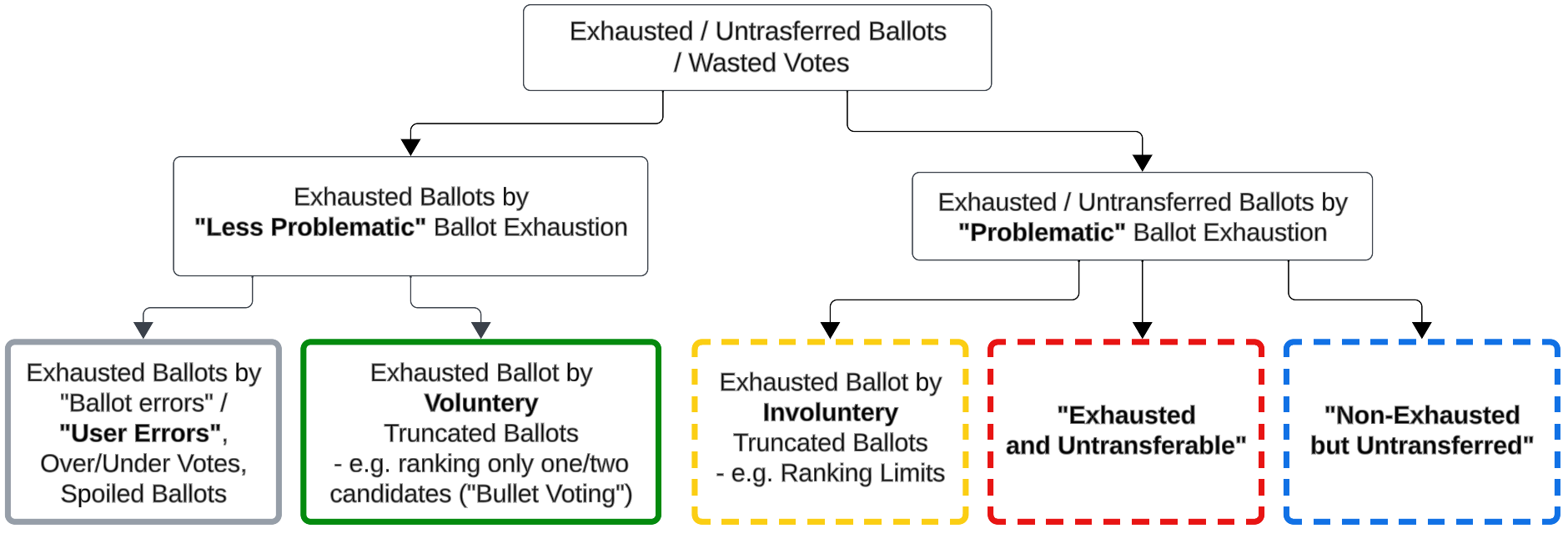
    • "Problematic" Ballot Exhaustion examples - RCV IRV

      We need three small, illustrative elections to demonstrate each ‘problematic’ box separately (avoid ‘Less Problematic’ Exhausted Ballots).

      Assumptions:

      • ranking limit 3 (or 5 if easier to re-create)
      • number of candidates 5 (or less if easier)
      • all voters correctly rank all the ballots (no spoilers, no bullet voting)
      • all voters rank all ranks within Ranking Limit (3 or 5)

      690199cf-e843-440a-aef0-3553e85d6265-image.png

      Context:

      • article https://docs.google.com/document/d/1ASC5BS10rCfAYZWGeCyS7dKdKc4p5wwI6DHs4F7ScGc/edit

      • presentation https://docs.google.com/presentation/d/1ipof9WSSy0GenVKWfKLu_jlYwUIT0TU0WVSAap0VZ5Q/edit#slide=id.g27f6bb33467_0_1

      Comments, feedback - very much appreciated!

      posted in Single-winner
      masiarek
      masiarek
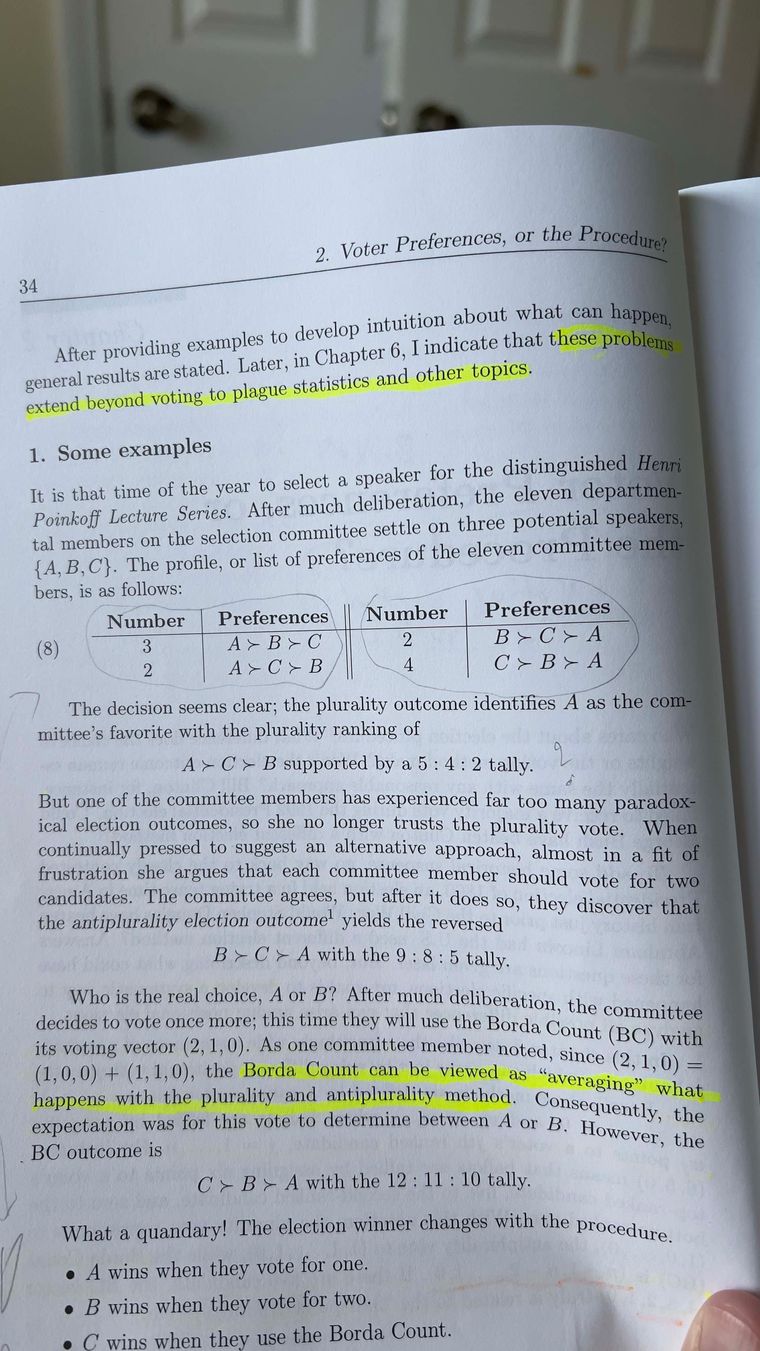
    • Book Chaotic Elections - Saari, page 34

      Book Chaotic Elections - Saari, page 34:
      page34_Chaotic_Elections_Saari3.jpg

      Strange Plurality voting notation:
      A > C > B supported by a 5 : 4 : 2 tally.

      Have you seen it somewhere?

      Additionally, it is strange to see 'ranks' for plurality voting results/winners (instead of 'chose-one').

      posted in Single-winner
      masiarek
      masiarek
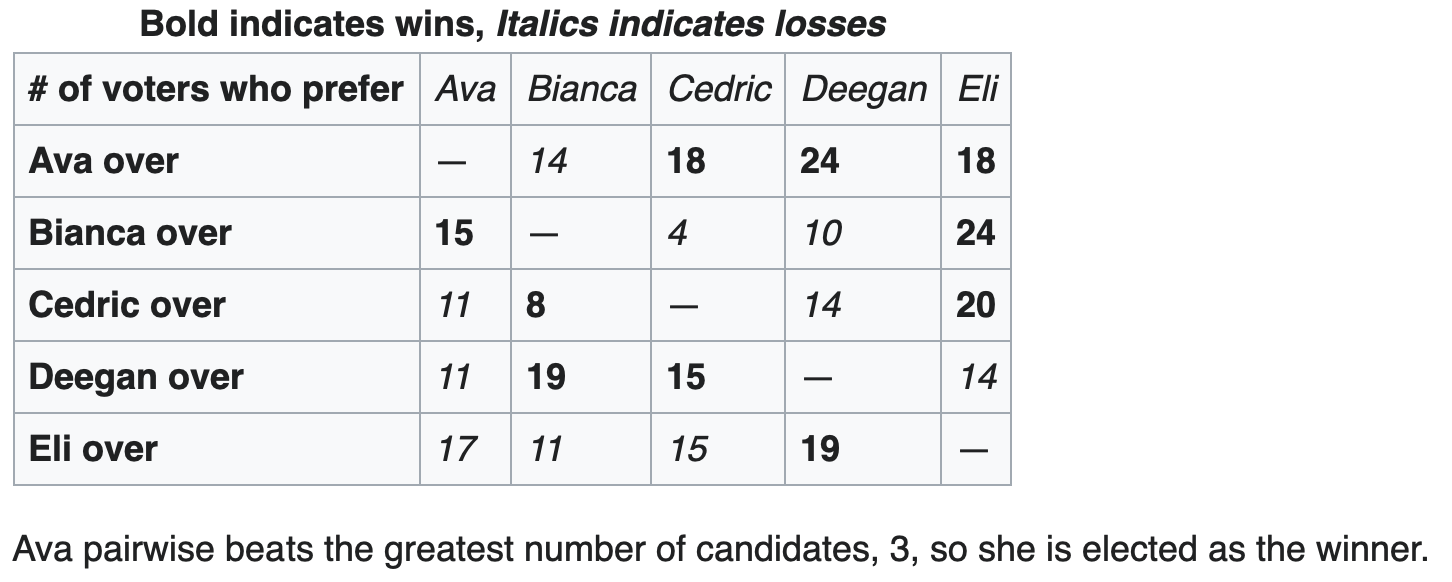
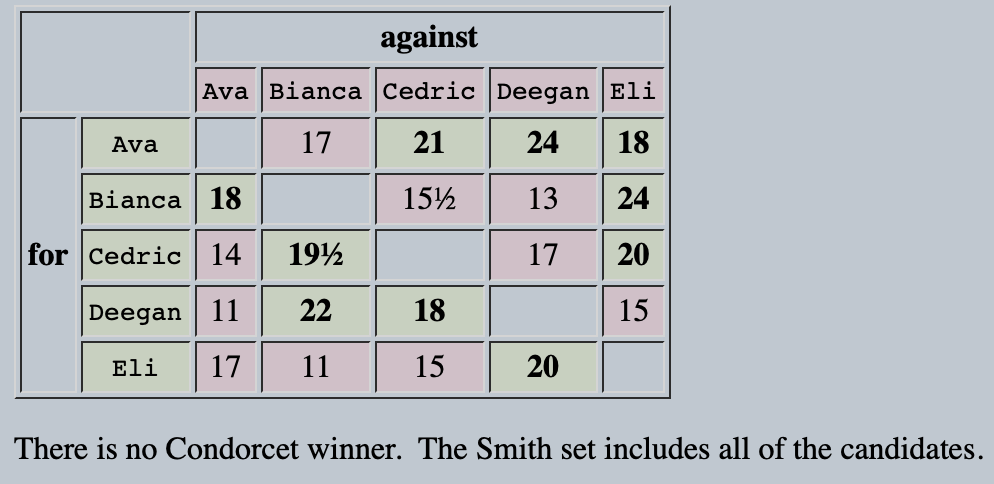
    • Ranked Robin - which preference matrix is correct?

      8:Ava>Cedric>Deegan>Bianca>Eli
      6:Ava=Bianca=Cedric>Eli>Deegan
      6:Eli>Ava>Bianca=Cedric=Deegan
      6:Deegan>Bianca=Cedric>Eli>Ava
      4:Bianca>Ava>Eli>Deegan>Cedric
      3:Eli>Deegan>Bianca=Cedric>Ava
      2:Deegan=Eli>Bianca=Cedric>Ava

      1. preference matrix at https://electowiki.org/wiki/Ranked_Robin:
        3359b14a-286b-4105-befd-b81ff2f1c124-image.png

      2. preference matrix at - https://www.cs.angelo.edu/~rlegrand/rbvote/calc.html
        31b1b5b7-94da-4dd6-af4a-5cadd9cdb27b-image.png

      posted in Single-winner
      masiarek
      masiarek
    • Voting example - PBS - different methods - different winners

      Youtube Video – [02:50..]

      Ranks
      G,B,P,R,O
      18:1,5,4,2,3
      12:5,1,4,3,2
      10:5,2,1,4,3
      9: 5,4,2,1,3
      4: 5,2,4,3,1
      2: 5,4,2,3,1

      Ranks converted into Scores
      G,B,P,R,O
      18:5,1,2,4,3
      12:1,5,2,3,4
      10:1,4,5,2,3
      9: 1,2,4,5,3
      4: 1,4,2,3,5
      2: 1,2,4,3,5

      Voting Method and Winner
      Plurality - Green
      Two-Round Runoff- Blue
      RCV IRV - Purple
      Borda - Red
      Range - Red
      Approval - Red
      Condorcet - Orange
      STAR Voting - Orange

      Here are my calculations: https://docs.google.com/document/d/1icQZ1efJV4XX7fD0_OTjNnW7uhfFV4lxbz5afTmqcyg/edit

      posted in Single-winner
      masiarek
      masiarek
    • Condorcet, IIA, monotonicity in RCV IRV

      ordered majority rule - Condorcet, IIA, monotonicity-not desirable properties ?!

      A Majority Rule Philosophy for Instant Runoff Voting
      https://arxiv.org/abs/2308.08430

      Conclusions
      IRV is the only voting method to satisfy ordered majority rule, which ensures the election of a candidate from the majority coalition while preventing opposition voters from influencing the choice of candidate from the faction they oppose. Ordered majority rule determines the relative social order between any two candidates by counting only ballots from those voters who do not prefer another major candidate, while ignoring all minor candidates.
      Ordered majority rule is incompatible with the Condorcet criterion and independence of irrelevant alternatives because Condorcet and IIA demand that the relative social ranking between two candidates should depend on the relative social ranking of these candidates on all ballots. In addition, it is incompatible with monotonicity because monotonicity demands that if supporters of minor candidates have influence over lower ranked candidates, then supporters of major candidates should have equal or greater influence, while IRV does not grant influence over the social ranking of two candidates by voters who prefer a different major candidate. For situations where allowing supporters of a major candidate to have influence over the relative social ranking between other major candidates is deemed inappropriate, compliance with Condorcet, independence of irrelevant alternatives, and monotonicity are not desirable properties of a voting system.

      posted in Single-winner
      masiarek
      masiarek
    • RE: **INTRODUCING** 2-Choice Voting (2CV) - An Improved Iteration on RCV and STAR

      My main objection - loss of expressive ballot.

      Plurality voting is among the least expressive voting methods there is available.

      2CV method seems to force voter to express opinion on two candidates only (lost expressiveness of the voting ballot).

      You may very well have opinions about some or all of the candidates on a ballot, and yet you only get a say about two candidates only.

      Other voting methods allow you to express yourself in different kinds of ways — for example:

      • approval voting allows voters to choose any number of candidates;
      • RCV lets you rank candidates by preference;
      • score or range voting asks voters to give each candidate a score, with the winner being determined by the candidate with the highest total or average score.
      • STAR Voting - multiple candidates - both score and preference !
      posted in New Voting Methods and Variations
      masiarek
      masiarek
    • Condorcet Winner - compare STAR and RCV IRV

      Both STAR and RCV can fail to chose CW (Condorcet Winner).

      How often does this happen?
      Do we have any GitHub simulation software to flash it out (ideally with few example ballots).

      posted in Single-winner
      masiarek
      masiarek
    • Stable Voting

      Not sure what it is - but I never heard this term before - hence posting it here:

      https://stablevoting.org

      https://github.com/voting-tools/stablevoting-backend

      posted in Single-winner
      masiarek
      masiarek
    • FairVote - later-no-harm (LNH)

      Is this factually correct - any comments, ideas?https://www.rankthevoteohio.org/rcv_is_not_a_condorcet_system

      Are these the best explanations? Anything else worth reading?
      https://www.starvoting.org/pass_fail
      https://electionscience.org/library/later-no-harm-criterion/
      https://en.wikipedia.org/wiki/Later-no-harm_criterion
      https://www.rangevoting.org/LNH.html

      posted in Single-winner
      masiarek
      masiarek
    • Condorcet Loser / Pairwise comparison / Preference Matrix
         A,B,C,D,E
      8: 3,0,1,1,1
      5: 0,4,0,0,0
      2: 0,1,3,2,1
      1: 0,2,5,4,3
      

      Who is the Condorcet Looser (CL) and Condorect Winner (CW)?
      How to build the Preference Matrix (find CW and CL) - Pairwise comparison.

      Assume that election officials tossed a coin ahead of time - and the following Candidates were selected as tie breakers:

      1. A
      2. B
      3. C
      4. D
      5. E
      

      Tiebreaker candidates are selected from the above list, preferring candidates with lower numbers.

      We have 4 seats to win (with 5 candidates) - who should win this election?

      posted in Multi-winner Bloc
      masiarek
      masiarek
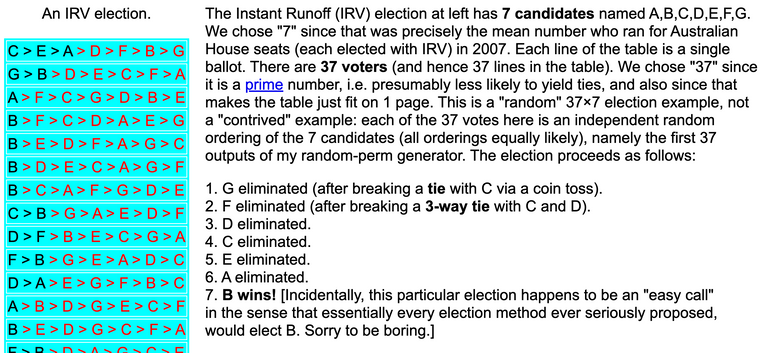
    • red parts of each ballot - RCV / IRV - how to find programmatically

      I would like to teak an existing Python RCV tabulation program to mark all the rankings (see below in red color) that have been ignored by RCV tabulation process (these are exhausted ballots). I want to be able to demonstrate to RCV folks how quickly and many exhausted ballots/rankings are ignored / discarded.

      how to find programmatically:
      https://www.rangevoting.org/IrvIgnoreExample.html - "the red parts of each ballot are ignored by the IRV process -

      What would be the best algorithm to find the red parts?
      f0b60996-0b0c-4b9c-be57-a02436e9c32b-image.png

      posted in Single-winner
      masiarek
      masiarek
    • RE: Pairwise Matrix / Preference / Ranked Pairs / Cardinal pairwise

      @toby-pereira Is there a difference in an approach between Scoring (Cardinal/Rating) and Rankings (Ordinal) with equal ranks ?

      Obviously the direction must be flipped

      • score - high numbers (4,5) - winners,
      • rankings - low numbers winners (1,2,3)
      posted in Electoral Theory 101
      masiarek
      masiarek
    • Pairwise Matrix / Preference / Ranked Pairs / Cardinal pairwise

      How to learn this lingo:

      Pairwise Matrix
      Pairwise preference
      Pairwise preference - Strength of preference and rated pairwise preference ballot.
      Ranked Pairs
      Score Sorted Margins
      Smith set vs Copeland set vs Schwartz set
      Approval Sorted Margins
      Pairwise Winner
      Ranked Winners
      Condorcet Winner (CW) / Loser (CL) / Improved Condorcet winner / Weak Condorcet loser
      Improved Condorcet winner
      Smith set vs Copeland set
      Cardinal pairwise, cardinal-weighted pairwise (CWP) comparison

      posted in Electoral Theory 101
      masiarek
      masiarek
    • RE: FairVote comparison: RCV, Approval, STAR, Range, Condorcet

      https://www.equal.vote/fv

      posted in Single-winner
      masiarek
      masiarek
    • FairVote comparison: RCV, Approval, STAR, Range, Condorcet

      FairVote voting methods comparison: RCV, Approval, STAR, Range, Condorcet - thoughts, comments?

      https://fairvote.org/resources/electoral-systems/comparing-voting-methods/#criteria-resistant-to-strategic-voting

      https://fairvote.org/resources/electoral-systems/comparing-voting-methods/#criteria-resistance-to-spoilers

      posted in Single-winner
      masiarek
      masiarek