Navigation

    Voting Theory Forum

    • Register
    • Login
    • Search
    • Recent
    • Categories
    • Tags
    • Popular
    • Users
    • Groups
    1. Home
    2. SaraWolk
    • Profile
    • Following 9
    • Followers 3
    • Topics 31
    • Posts 194
    • Best 66
    • Groups 3

    Sara Wolk

    @SaraWolk

    Sara Wolk is the Executive Director of the Equal Vote Coalition, a non-profit fighting for true equality in the vote itself. Sara is a dedicated community organizer who has been leading the Oregon movement for voting reform since 2016 when she was elected to chair the RCV-Oregon research committee on alternative voting methods. It was the work of this committee which changed her mind. STAR Voting was the only method that delivered on the committee's core goals. With a background in sustainability, design, and music, she is looking forward to building the kind of coalition that can reshape democracy. Systemic problems require systemic solutions.

    84
    Reputation
    71
    Profile views
    194
    Posts
    3
    Followers
    9
    Following
    Joined Last Online
    Email sara@equal.vote Website starvoting.us Location Oregon

    SaraWolk Unfollow Follow
    Forum Council Global Moderator administrators

    Best posts made by SaraWolk

    • Utah votes down RCV, citing monotonicity and not wanting to go with a stepping stone reform and then have to change again.

      Take a look at this video. A City in Utah just voted 5-2 against implementing IRV. Stated reasons, they'd rather have STAR voting and don't want to pass a stepping stone and then change it, and monotonicity.

      Here's a discussion at one of the more interesting comments. https://youtu.be/TQbr4KYzxR4?t=11667

      posted in Current Events
      SaraWolk
      SaraWolk
    • RCV found unconstitutional in Maine.

      The Supreme Court of Maine has once again ruled on the constitutionality of Ranked Choice Voting, again finding it to be unconstitutional.

      In 2017 they had ruled that RCV was not compatible with Maine's requirement for a Plurality winner (the candidate with the most votes wins). In RCV, ballots are initially counted as votes for first-choice candidates, but those same votes can later be transferred or discarded, meaning the final winner may not be the candidate who received the most votes as originally cast.

      “The Constitution requires that the person elected shall be the candidate who receives a plurality of all the votes.”
      “Under the ranked-choice voting system… if no candidate receives a majority of first choice votes, the last-place candidate is eliminated and the votes cast for that candidate are redistributed to the voters’ next choices.”
      “It is therefore possible that the candidate who receives the greatest number of first choice votes will not be declared the winner.”
      “Because the Act requires the Secretary of State to determine the winner… by eliminating candidates and redistributing votes until one candidate receives a majority, the [Ranked Choice Voting] Act is not consistent with the provisions of the Constitution that require election by plurality.”
      -Opinion of the Justices (Maine 2017 RCV Advisory Opinion)

      The new 2026 ruling takes a look at the conflicting Alaska court ruling on the same subject and once again rules that RCV can find and then reject the plurality winner in favor of someone else.

      The new ruling also goes deeper into the 2nd RCV constitutional issue, regarding centralization of ballots required under RCV.

      Article IV, Part First, § 5 (House)

      “The votes shall be received, sorted, counted and declared in open ward, town and plantation meetings…”

      Article IV, Part Second, § 3 (Senate)

      “The votes shall be received, sorted, counted and declared in the same manner as votes for Representatives…”

      Article V, Part First, § 3 (Governor)

      “The votes shall be received, sorted, counted and declared… and the lists of votes shall be sealed and returned to the Secretary of State…”

      RCV does not allow for local tabulation of ballots due to the fact that a local or subset of ballots isn't enough to determine the order of elimination, thus there's no way to know which rankings and transfers should be counted and which ballots should be exhausted until the central tally is complete. The Maine Constitution requires that votes be counted and declared by local officials as cast, with those results transmitted to the state.

      This has massive implications for RCV nationwide. 39 states include a clause of some sort requiring Plurality winners in their elections. 8 states include a clause requiring local tabulation and reporting of vote totals in their constitutions.

      RCV also violates common clauses in state constitutions that Maine doesn't have, including "vote for one" clauses, "count all votes" clauses, and "Equal Vote" clauses. Many more states have laws similar to those above that implicitly exclude RCV, and now 19 states have explicit bans on RCV.

      For decades the argument in the voting reform community has been that we should go with RCV (despite warnings from the electoral science community) because of momentum. I think that argument can now officially be laid to rest.

      It's worth noting that STAR Voting and Approval Voting both comply with the Maine Constitution's plurality winner rule. STAR Voting only finds the Plurality winner once, in the Automatic Runoff round. It clearly defines the vote as the runoff vote and defines scores as ballot data - not votes. Votes are never reassigned, transferred, or exhausted. Your vote goes to the finalist you prefer or counts as equal support for both, essentially like an abstain between those two. The candidate with the most votes wins.

      STAR also is compatible with local tabulation of ballots, (subtallies report score totals for each candidate and a voter preference table). In STAR all ballot data is fully counted and used.

      It's time that we as a movement recognize that RCV is a dead end and stop throwing good money after bad.

      https://ballot-access.org/2026/04/07/maine-supreme-judicial-court-again-says-ranked-c[…]l-elections-for-state-office-unless-constitution-is-changed/

      posted in Single-winner
      SaraWolk
      SaraWolk
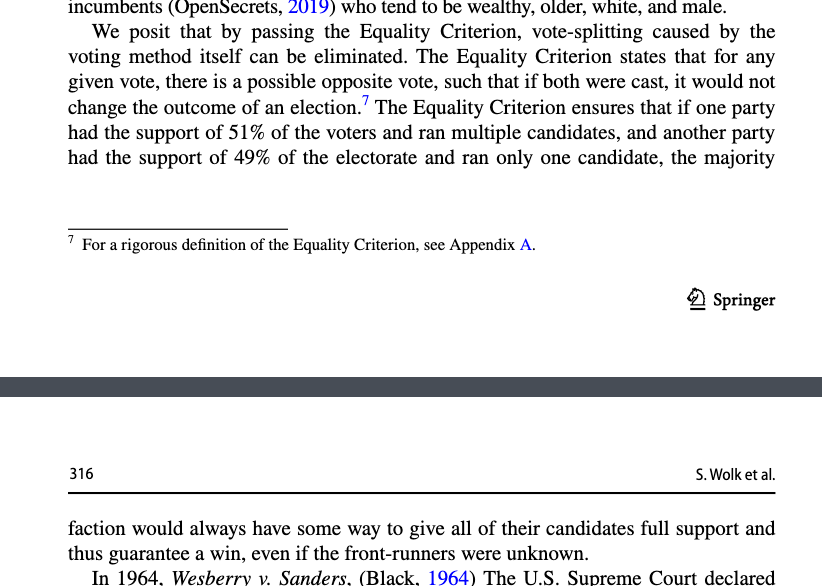
    • RE: My work and the definition of the Equality Criterion

      @bternarytau I do remember that exchange as you said as well and I was also in a blur with a number of things happening all at once (I submitted that first draft on my way to the airport to get surgery cross country,) so my apologies for not following up as I should have or remembering that we'd left this a loose end.

      My memory is still a bit foggy on what exactly we ended up using as the formal definition, since it was almost a year and a half ago, so I'm going to take a closer look at it right now and see what I can do.

      I can say that since the definition in the hard printed part of the issue is Mark Frohnmayer's, and the more rigorous definition you'd been working on is in the appendix, which will be hosted online, we should still be able to put in changes and credit or cite you, so please give some thought to what you would like that citation to be exactly and email me at sara@equal.vote to follow up.

      posted in Research
      SaraWolk
      SaraWolk
    • RE: Allocated score (STAR-PR) centrist clones concern

      @wolftune My understanding, correct me if I'm misremembering, is that a quota rule for cardinal methods like this is ensured if voters bullet vote, Party List style, but not necessarily if they don't. This seems like an edge case example of that, and it does seem like an edge case, but it raises good questions. (That I'm planning to post in a dedicated thread soon, when I have time to engage with the replies.) Namely, the definition of proportionality used for ordinal methods is pretty crude for describing Cardinal or Condorcet PR.

      Cardinal PR (unlike Ordinal) can allow voters and factions to coalition naturally (even if the candidates or parties don't) by addressing vote-splitting, and they also combat the notorious PR polarization stagnation that academics warn about, but they can't also always fend off against the mythical homogenized centrist who everyone agrees is meh.

      This is an example of why I like STAR more than Score, and we haven't fully applied those principles to PR.. yet. I still think a hybrid approach is the key to unlocking that next level.

      Our STAR-PR committee looked at a few options for selection, including highest score (simplest) and Monroe (which I think would address this.) Highest score won out, but realistically the two were pretty well dead tied.

      In any case, I think that Clones are a much bigger problem in hypothetical math scenarios than they ever will be in real life campaigns, and if a faction can really pull off running 2 or 3 clones that all break through and win over voters then that's frankly impressive. The reality is that if voter behavior doesn't do them in, limitations in campaign funding and volunteer power likely will.

      I'd still take STAR-PR edge cases over STV edge cases, but I won't claim it's perfect and that nobody will ever come up with something even better. This is still the cutting edge of voting theory.

      posted in Proportional Representation
      SaraWolk
      SaraWolk
    • RE: The dangers of analysis paralysis in voting reform

      @toby-pereira said in The dangers of analysis paralysis in voting reform:

      Ranked Robin

      We are planning to come back to the original intention around Ranked Robin, which is to stop branding Condorcet as a whole bunch of systems to fight between, and move to calling them one system, Ranked Robin, with a variety of "tie breaking protocols" a jurisdiction's special committee on niche election protocols could choose between. Honestly, specifying Copeland vs RP vs Minimax is way beyond the level of detail that should even be written into the election code or put to the voters.

      Equal Vote's point with the Ranked Robin was never to say that Copeland is better than Ranked Pairs is better than Smith/Minimax. The point is that these are all equivalent in the vast, vast majority of scaled elections and that Condorcet as a whole is top shelf so it should be presented to voters as a better ranked ballot option. Ranked voting advocates should support it. The main reason Condorcet is not seriously considered is because of analysis paralysis and a total lack of interest in branding and marketing for simplicity and accessibility.

      posted in Voting Methods
      SaraWolk
      SaraWolk
    • Reddit: Reconsidering the r/EndFPTP Rules

      Check out this post on Reddit.

      Comment and discuss. The proposal is to change rule #3 from "Do NOT bash alternatives to FPTP" to "Keep criticisms constructive and keep claims factual".
      https://www.reddit.com/r/EndFPTP/comments/124861h/reconsidering_the_endfptp_rules/

      posted in Advocacy
      SaraWolk
      SaraWolk
    • RE: Addressing Spam Posts

      Thank you both for keeping an eye on this and deleting the spam. If you have suggestions for the settings I'm open to whatever seems like the best option. I don't have strong opinions either way as long as people like you both are taking care of it if it does occur.

      If that wasn't the case I'd say we should look into other options.

      posted in Forum Policy and Resources
      SaraWolk
      SaraWolk
    • Threaded replies show up both as a threaded reply and at the end of the feed.

      I think that's a bit confusing and redundant. Having replies only show up under the comment they are replying to would be better.

      posted in Issue Reports
      SaraWolk
      SaraWolk
    • RE: My proposal for this forum

      Hi everyone,
      I'd like to share some information for people who might have missed previous threads or comments, and I'd like to offer a proposal.

      For reference:
      Key Motions Passed in Council Meetings (all unanimous!):
      Motion 1, v2: “To establish an independent organization with the purpose of owning and maintaining the online discussion forum.”
      Motion 2 v2: “Move to establish and try to publish an online discussion forum based on the “NodeBB” forum software.”
      Motion 3: “To do due diligence and apply best practices to protect and minimize the storage of PII of users, with these responsibilities explicitly delegated to specific responsible individuals trusted by the council/board.”
      Motion 4: “Create a tech committee empowered to make non-controversial “technical decisions” on behalf of the group as needed, with the understanding that the council could revisit those decisions later if needed. The committee should consult the council on questions where the decision may be controversial.”
      Motion 5: “Order of operations. 1. Pass bylaws. 2. Elect board. 3. Launch website.”
      Motion 6: “Adopt categories list”
      Motion 7: “Adopt Code of Conduct, Terms of Service, Privacy Policy.”
      Motion 8: “Motion passed unanimously to coalition with Equal Vote and receive donations and pay expenses through Equal Vote account.”

      Resources:
      Bylaws: https://docs.google.com/document/d/1obwaF82x5022V_K-gifdv7Why-O5LzqFAiB_d4EwqAw/edit?usp=sharing
      Procedure Manual: https://docs.google.com/document/d/1TCRbEXuBqY8N1glKf7YHNWMVIWD7blgZQhwomfteigY/edit?usp=sharing
      Privacy policy. Ready for review. https://docs.google.com/document/d/1QzZp2QAsP60Ti1WWPk29Q8dInGIM2l438rcJDZLd2Ug/edit?usp=sharing
      Terms of Service: https://docs.google.com/document/d/1AlnP1gvvc986n0iiYYkA0Tc9L33erbxDftM7sX5ypz4/edit?usp=sharing
      Code of Conduct: https://docs.google.com/document/d/1ExGrryHIFOjSfPiTtHYBRPw7GQY8lRsCfWiWsLEsImc/edit?usp=sharing

      Forum Council Members:
      Sara Wolk, William "Jack" Waugh, David Hinds, Connor Frankston, Micah Fitch.
      Moderators:
      Sara Wolk. Connor Frankston, David Hinds, Connor Frankston, Micah Fitch, Gary Litke.
      Tech Committee
      William Waugh, (Rob Brown was added by Jack and keys have been shared but that has not been officially authorized yet).

      Key points: This forum already has a Council that governs it in terms of the big picture decisions. It also has a tech team and moderation team that can work on things and address issues as needed. They are also empowered to make non-controversial decisions without needing to call a Council meeting or jump through unnecessary hoops. The Forum Council can also approve decisions between meetings, as it has done in the past. The main barrier to progress as I see it is that we could use more volunteers to help. If you'd like to volunteer, email us at forum@equal.vote.

      I don't think there is any benefit to rehashing our processes or decisions that have already been made with plenty of consideration and lots of input from Council Members (past and current) and with input gathered from Forum participants at large through the forum itself. To date all our votes since the forum launched have been unanimous.

      I do think it's very problematic to make consequential or controversial decisions via forum posting. That opens the door to leadership who don't have the time to read all the posts missing a huge decision. Meetings also allow us to bring in perspectives from other spaces where relevant discussion takes place. Voting via forum post would make it next to impossible to ensure that people have read the relevant discussions and have the background needed before they vote. I love the idea about getting feedback from participants and taking polls to inform council decisions, as we have always done, but for bylaw level items, an actual meeting with real face to face discussion protects the longevity and integrity of the forum much better.

      For those who don't know me, I've put in a lot of time and effort over the last 2 years to help build an inclusive, robust, and stable forum that will be an asset to our community for years to come. We included everyone in that process start to finish who wanted to contribute. All the work I've put in has been done in a volunteer capacity, (not as part of my job with Equal Vote). I was really excited and proud to have finished our long list of meta level set up tasks (see resource list above) and hope to not spend too much time revisiting them. The more fun work of making the forum better and bigger and discussing voting science is still ahead.

      My Proposal for Forum Next Steps:

      1. We recruit some new volunteers to our Forum Council, Tech Committee, and Moderation Committee. Each of these requires a different time commitment and skill set so finding the right people for each task is important. Email forum@equal.vote to volunteer.
      2. We don't waste time rehashing process and governance level conversations unless there is a specific need to do so.
      3. Jack finishes passing the keys for management and billing of the forum to Equal Vote so Equal Vote can pay for the Forum's hosting and URL with the new grant money we recently obtained for software dev. The Forum is still autonomous, this is just a coalition service that we've gotten agreement from both boards on. This ensures that our Forum assets will be protected and will be renewed and paid for and that keys can be passed easily if needed. (Right now it's under Jack's personal account, which is problematic.) This is all in accordance with what was decided already, and allows us to ensure that the council has recourse if any one person goes AWOL or if there is a problem with an individual admin. Everyone is in agreement that the Forum should be and stay autonomous to keep it welcoming for advocates of all types of reforms.
      4. We have our next Council Meeting soon. Everyone who would like to attend or volunteer, please put in your availability here.
      5. We keep the forum constructive and drama free. We resolve any issues or disputes that might come up (such as Rob's here) by reaching out to each other more directly so we can hopefully avoid stress and hurt feelings or unnecessary escalation. I think that keeping posts like this off the forum itself unless other avenues have been tried and failed will help recruit and retain volunteers and forum participants in general. It will certainly help me be more comfortable inviting new people to join us here.

      In order to improve engagement on this forum we should double down on the commitments we've already made to make this a non-toxic space for new people and to keep our current volunteers motivated to complete the action items already on the list.

      posted in Meta Discussion
      SaraWolk
      SaraWolk
    • RE: Approval Voting as a Workable Compromise

      I agree that Approval is a workable compromise and I think it should be the default voting method (as opposed to Choose One Plurality.)

      On whether it should be the one reform we all work to implement, I don't agree. I don't think Approval is persuasive, and I don't think it's competitive against RCV, the status quo in voting reform. I wish it was.

      I absolutely encourage advocates to continue to advocate, and I'll keep advocating for it, but I'm more persuaded now than ever that we need a reform that is scaleable, viable, and that delivers on the goals set out by RCV advocates while addressing it's serious pitfalls.

      Approval voting tells inspired voting reformers to stop caring about the things they think they want, to change their priorities, and to trust the simulations over their intuition. That's not a winning pitch. The many benefits of Approval are neither transparent or self-evident to lay people and it appears to violate one person one vote, even though it should be the gold standard.

      posted in Election Policy and Reform
      SaraWolk
      SaraWolk

    Latest posts made by SaraWolk

    • RE: Smith Primary to Approval

      @jack-waugh

      I list both names because Clay said he was involved with defining the balance condition.

      I don't think so, but Clay was involved with the invention of STAR Voting. Maybe that's what you were thinking of or what he meant? I could be wrong. In any case we generally are trying to move away from naming things after people which is why this was named the Equality Criterion and then codified as such in the halls of peer review. Something we all worked very hard to do.

      Clay and Mark both deserve quite a lot of credit for their many contributions, but let's help these terms and criteria catch on by being consistent with using their formal names.

      Screenshot 2026-04-23 at 1.11.38 AM.png

      posted in Advocacy
      SaraWolk
      SaraWolk
    • RE: Smith Primary to Approval

      On the technical properties there are no issues here.

      On the practical considerations there are a number.

      1. It requires explaining the Smith Set
      2. It requires explaining Condorcet winners
      3. It requires explaining Approval voting.
      4. It requires introducing two new voting methods , with two different ballot types, each with different instructions, at the same time.

      I recommend having one voting method only. If you want to have a primary and general then use the same good method for both and don't narrow it down too much before the general. That's actually simpler and will get much broader support from stakeholder factions and minor parties who want real choices on the general election ballot.

      Condorcet is accurate enough to just skip the primary all together unless there are too many candidates. If you want Condorcet with a simple tiebreaker why not just make the tiebreaker between the finalists (tied candidates) automatic in the event that it's even needed? In the tiebreaker, each voters ballot counts as a vote for their favorite(s) still in the running. If a voter ranked two candidates equally that would count as a vote for both. The finalist with the most votes wins.

      The tiebreaker never even has to be explained. It's literally just a built in tiebreaker like a Plurality provision might call for a drawing of lots or a coin toss, but the ballots already have the tiebreaker info they need so it can be done instantly.

      posted in Advocacy
      SaraWolk
      SaraWolk
    • RE: RCV found unconstitutional in Maine.

      @toby-pereira Anything can be argued and counter-argued in court, but my assessment above is based on what a fair and likely ruling would be, in my professional opinion.

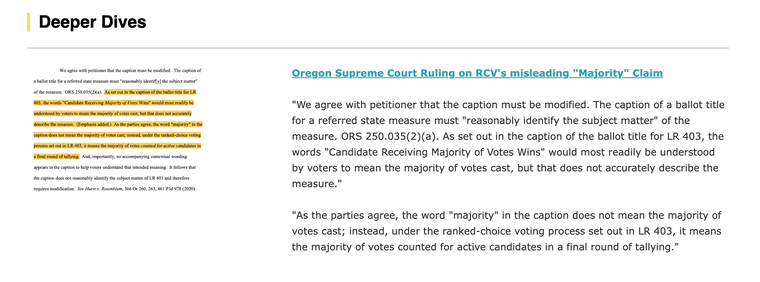
      I'm not a lawyer, but have been studying these things for years and we did win the case in the Oregon Supreme Court against the Oregon Legislative Council which found that RCV's ballot title in Oregon was misleading and inaccurate as it pertains to RCV's majority winner claims, though there is apparently no mechanism anymore to enforce such a ruling.

      Two confounding data points:

      1. RCV has spent years making the argument that RCV guarantees majority winners. That's directly at odds with an argument that it guarantees plurality winners. Ironically, there's a solid case to be made that due to exhausted ballots it guarantees neither.
      2. The Constitution of Maine Article IV, Section 5 requires that winners be elected "by a plurality of ALL votes returned.” In cases like these where the wording is explicit that it's "all" votes "returned" or all votes "cast" RCV is eliminated from compliance by the existence of exhausted ballots alone.
        Screenshot 2026-04-15 at 6.15.24 PM.png
      posted in Single-winner
      SaraWolk
      SaraWolk
    • RE: RCV found unconstitutional in Maine.

      @psephomancy Even if we wanted to, redefining the term "Ranked Choice Voting" isn't within our power. They have clear and defensible trademark over the term, which again, was coined specifically for IRV, not to mention name recognition for RCV by millions of people that they've invested millions of dollars to build.

      Terminology in voting science is already so jumbled. Conflating good ranked methods (Condorcet) with Ranked Choice Voting (IRV & STV) or Instant Runoff Voting (IRV only) is only going to hurt the better options in the scenarios where RCV is a dirty word, while in contexts where RCV is well regarded, conflating better ranked methods serves no benefit because RCV dwarfs all the other alternatives in terms of name recognition and market dominance.

      Our only way forward here is to out RCV as the outdated and oversold method that it is, position better alternatives as the successor, and move forward from there. Strategically.

      posted in Single-winner
      SaraWolk
      SaraWolk
    • RE: RCV found unconstitutional in Maine.

      @Jack-Waugh

      Etjon Basha asks, "So, not even approval would pass? Nothing beyond plurality?".

      In this context, "plurality" doesn't mean "Choose One Only" Voting or FPTP. Plurality means a class of systems where the candidate with the most votes wins, as opposed to "majority" voting systems in which the candidate with the majority of votes cast wins.

      Approval is a plurality method.

      posted in Single-winner
      SaraWolk
      SaraWolk
    • RE: RCV found unconstitutional in Maine.

      @toby-pereira
      In RCV a vote is the voters top choice in the first round and each round following. The first round finds the Plurality winner and if that candidate has a majority of active votes the election is called right then and there, but if that winner has a plurality of votes but not a majority of active votes, the system may reject that and go on to find a separate winner by reallocating or exhausting those votes. That's why it's not a Plurality method.

      In STAR Voting the first round never determines a winner because votes haven't been awarded to candidates yet. That always happens only once in STAR Voting and the candidate with the most votes always wins.

      posted in Single-winner
      SaraWolk
      SaraWolk
    • RE: RCV found unconstitutional in Maine.

      @cfrank This is about Ranked Choice Voting, ie Instant Runoff Voting. Not ranked ballots in general.

      PSA: Ranked voting is a great umbrella term. "Ranked Choice Voting" is only an umbrella term for IRV and STV. It does not and never has referred to other ranked methods outside that family. It was explicitly coined for IRV by Fan Francisco, who thought the term "instant" was misleading for voter education since the results are not instant with IRV.

      At some point Equal Vote started incorrectly sharing something to the contrary, but we were wrong.

      It's really important to differentiate from Ranked Choice Voting, so it's really important that we stop using the term for other ranked methods.

      posted in Single-winner
      SaraWolk
      SaraWolk
    • RCV found unconstitutional in Maine.

      The Supreme Court of Maine has once again ruled on the constitutionality of Ranked Choice Voting, again finding it to be unconstitutional.

      In 2017 they had ruled that RCV was not compatible with Maine's requirement for a Plurality winner (the candidate with the most votes wins). In RCV, ballots are initially counted as votes for first-choice candidates, but those same votes can later be transferred or discarded, meaning the final winner may not be the candidate who received the most votes as originally cast.

      “The Constitution requires that the person elected shall be the candidate who receives a plurality of all the votes.”
      “Under the ranked-choice voting system… if no candidate receives a majority of first choice votes, the last-place candidate is eliminated and the votes cast for that candidate are redistributed to the voters’ next choices.”
      “It is therefore possible that the candidate who receives the greatest number of first choice votes will not be declared the winner.”
      “Because the Act requires the Secretary of State to determine the winner… by eliminating candidates and redistributing votes until one candidate receives a majority, the [Ranked Choice Voting] Act is not consistent with the provisions of the Constitution that require election by plurality.”
      -Opinion of the Justices (Maine 2017 RCV Advisory Opinion)

      The new 2026 ruling takes a look at the conflicting Alaska court ruling on the same subject and once again rules that RCV can find and then reject the plurality winner in favor of someone else.

      The new ruling also goes deeper into the 2nd RCV constitutional issue, regarding centralization of ballots required under RCV.

      Article IV, Part First, § 5 (House)

      “The votes shall be received, sorted, counted and declared in open ward, town and plantation meetings…”

      Article IV, Part Second, § 3 (Senate)

      “The votes shall be received, sorted, counted and declared in the same manner as votes for Representatives…”

      Article V, Part First, § 3 (Governor)

      “The votes shall be received, sorted, counted and declared… and the lists of votes shall be sealed and returned to the Secretary of State…”

      RCV does not allow for local tabulation of ballots due to the fact that a local or subset of ballots isn't enough to determine the order of elimination, thus there's no way to know which rankings and transfers should be counted and which ballots should be exhausted until the central tally is complete. The Maine Constitution requires that votes be counted and declared by local officials as cast, with those results transmitted to the state.

      This has massive implications for RCV nationwide. 39 states include a clause of some sort requiring Plurality winners in their elections. 8 states include a clause requiring local tabulation and reporting of vote totals in their constitutions.

      RCV also violates common clauses in state constitutions that Maine doesn't have, including "vote for one" clauses, "count all votes" clauses, and "Equal Vote" clauses. Many more states have laws similar to those above that implicitly exclude RCV, and now 19 states have explicit bans on RCV.

      For decades the argument in the voting reform community has been that we should go with RCV (despite warnings from the electoral science community) because of momentum. I think that argument can now officially be laid to rest.

      It's worth noting that STAR Voting and Approval Voting both comply with the Maine Constitution's plurality winner rule. STAR Voting only finds the Plurality winner once, in the Automatic Runoff round. It clearly defines the vote as the runoff vote and defines scores as ballot data - not votes. Votes are never reassigned, transferred, or exhausted. Your vote goes to the finalist you prefer or counts as equal support for both, essentially like an abstain between those two. The candidate with the most votes wins.

      STAR also is compatible with local tabulation of ballots, (subtallies report score totals for each candidate and a voter preference table). In STAR all ballot data is fully counted and used.

      It's time that we as a movement recognize that RCV is a dead end and stop throwing good money after bad.

      https://ballot-access.org/2026/04/07/maine-supreme-judicial-court-again-says-ranked-c[…]l-elections-for-state-office-unless-constitution-is-changed/
      posted in Single-winner
      SaraWolk
      SaraWolk
    • RE: Is Duopoly More Resistant to Fascism?

      @cfrank If others have examples, simulations, or citations for my claim that "over time the two opposing factions become more and more polarized” I'd love to have those on hand too. I'm not sure I'm referencing any one thing I've read or heard in particular, but more putting multiple things together to get the big picture.

      On the math alone I think you're right that the center is an important block for the two parties to court as well, but in practice I think that that incentive is outweighed by the other perverse social incentives to demonize the other side, to punish "traitors" considering switching, and so on.

      Cancelling people who question the party line costs center voters, but it also discourages others from following. I think this was the subliminal Democratic Party tactic over the last decade that paid dividends for a while but then ultimately lost them the "big-tent" advantage and the presidency. I'm not saying it was an intentional strategy. There are big cultural forces at play here. That's obviously my own personal opinion.

      Back on topic: As the narrative gets dominated by two polarized factions and the middle is silenced, the real middle (the center of public opinion) almost ceases to be a part of the political spectrum because it's doesn't actually map on to the left, right, and swing voter boxes.

      Identifying and presenting consensus win-win policy and then getting it passed is the goal. We need to incentivise and empower that one way or another.

      posted in Political Theory
      SaraWolk
      SaraWolk
    • RE: Is Duopoly More Resistant to Fascism?

      @cfrank I have been thinking about the same questions. I think that the safeguard to fascism is ensuring checks against polarizing factions taking control.

      In FPTP two party domination, the center-squeeze effect ensures that over time the two opposing factions become more and more polarized and this gives the illusion of majoritarianism, but as we know, the electability bias from voters having to vote for the frontrunner on their side can wildly inflate the perceived popularity of those frontrunners. In practice the moderate and third party voices are silenced and we see super polarizing candidates like Donald Trump (who initially only had some 25% of the vote in the 2016 primary) winning decisive control of their party. His own party has little they can do if they don't like his leadership, and the opposing party also has no leverage whatsoever if they can't beat him head to head. This last presidential election we saw both parties put forward candidates with record low approval ratings, but nobody else had a chance of challenging them at the same time. This is textbook polarized entrenched two party domination.

      Meanwhile, I'm not convinced that a multi-party system on it's own will address any of that and it could make it worse. Just as choose one ballots can create a center-squeeze in FPTP, they can do the same in PR, resulting in a donut of polarized factions represented and little to no representation for the middle. In an election where the quota to win is 10% for example, a candidate could theoretically be strongly opposed by 90% of the electorate. Meanwhile, other factions could win with their standard-bearer also preferred by 10% of the electorate, but also strongly supported by many more and only strongly opposed by a slim minority.

      When some winners are hyper-polarizing and others are not, it not only allows for the rise of dangerous factions who are more likely to bring about civil war, it also creates a lopsided and unstable winner-set. That's not the idealized definition of proportionality we're aiming for even though it would technically pass PR criteria. Theoretically, we should be able to do better.

      The magic of a more expressive ballot or especially a 5 star ballot is that voters can show not only who their favorites are, but how much they like and dislike candidates from other factions. In an ideal system, this data could then be used to:
      a) ensure that factions who deserve a seat at the table get one, and
      b) ensure that candidates or factions that are seen as dangerous and harmful by others are not platformed when better alternatives exist.

      In single-winner STAR, voters who are in the minority who are not going to get their favorites elected still have a strong vote against their worst case-scenario in the runoff. This is a massive check on authoritarianism and fascism. This is amazing and we don't need to switch to PR to get this windfall.

      And, in a top shelf 5 STAR-PR system, theoretically we could do the same, using scores to identify which candidates and factions meet quota rules, while using scores and runoffs or preference data to identify the most polarizing and most opposed candidates.

      At best, PR systems boast that legislatures where all perspectives are represented at the table. These legislatures are more likely to put forward more broadly acceptable legislation, but at their worst, they can give extremist factions massive leverage to cause stagnation or tear the system apart from the inside. For example, a super polarizing candidate like Israel's Ben Gvir who was elected with only 3.5% of the vote has the power to make or break the majority coalition and call a new election with a vote of no confidence if Netanyahu defies him. At worst, PR systems can give small polarizing factions extremely disproportionate leverage. Some of this can only be reformed with governmental system reforms such as higher quotas, but some of it can be fixed with the voting method itself.

      Again, I think with a more expressive ballot and a hybrid ordinal and cardinal (STAR) approach we can do better.

      posted in Political Theory
      SaraWolk
      SaraWolk